
A typology of artificial and heavily modified water bodies, as defined by the Rules on Surface Water Bodies (Official Gazette of the Republic of Slovenia 63/05, 26/06, 32/11): preparation and provision of technical bases for the implementation of the Water Framework Directive (2000/60/EC)
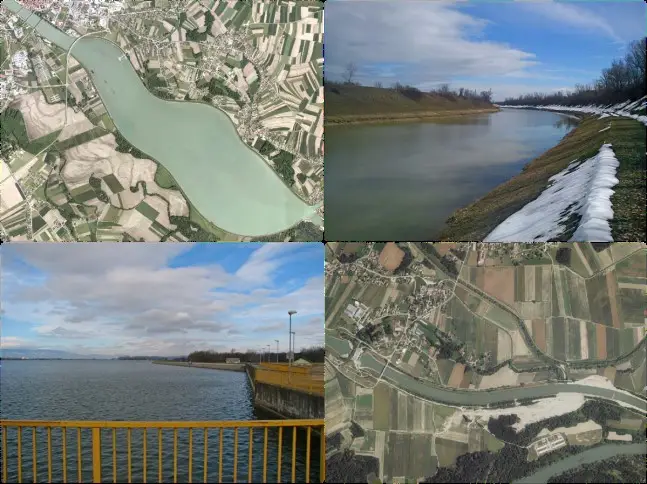
In accordance with Annex II to the Water Framework Directive, each body of water must be classified into its own type, including artificial (UVT) and heavily modified (MPVT) bodies of water. HMWBs are bodies of surface water which, due to physical alterations caused by human activity (e.g. transverse structures and dams for the purpose of electricity generation or flood risk reduction), have significantly altered characteristics, reflected primarily as hydrological and morphological changes and the disruption of longitudinal connectivity. UVTs are surface water bodies created by humans. UVTs and MPVTs are distinguished in accordance with the descriptors for the type of surface water (watercourse/river, lake, estuary, coastal sea) that most closely resembles that heavily modified or artificial water body. According to the Rules on the Designation and Classification of Surface Water Bodies (Official Gazette of the Republic of Slovenia, Nos. 63/2005, 26/2006, 32/2011), there are 19 MPVTs and 4 UVTs in Slovenia.
In this study, we first classified each MPVT or UVT into one of four categories – lake, watercourse/river, sea and estuary – based on the characteristics of the natural water body that most closely resembles the MPVT or UVT. We then classified the MPVTs and UVTs into existing (ecological) water types or new (ecological) water types using existing or additional descriptors in accordance with the Water Framework Directive. We classified the UVTs and MPVTs into 18 ecological types: one type of coastal sea, one type of estuary, and eight types each of lakes and watercourses/rivers. We highlighted the dilemma posed by significant differences in the characteristics of different parts of the same water body, as some MPVTs encompass both free-flowing and impounded sections, and the full range of hydromorphological conditions is often present. We verified the appropriateness of classifying MPVTs and UVTs into ecological types using data on organism communities, which we use to assess the ecological status or potential of surface waters in accordance with the Water Framework Directive. This typology provides a basis for developing methods to assess ecological potential and for determining mitigation measures for MPVT and UVT.
About the project
Client
Ministry of the Environment and Spatial Planning
Project leader
Assoc. Prof. Dr Gorazd Urbanič
Collaborators
Dr Vesna Petkovska
Dr Rebeka Šiling
Miha Knehtl
Dr Nataša Dolinar
Dr Urška Kuhar
Špela Remec-Rekar, MA
Bernarda Rotar
Maja Sever
Assoc. Prof. Dr Tina Eleršek
Dr Janja Francé
Dr Gorazd Kosi
Dr Borut Mavrič
Dr Martina Orlando-Bonaca
Associate Professor Dr Mateja Germ
Associate Professor Dr Alenka Gaberščik
Dr Samo Podgornik
Project duration
2015
OTHER DOMESTIC REFERENCES
