
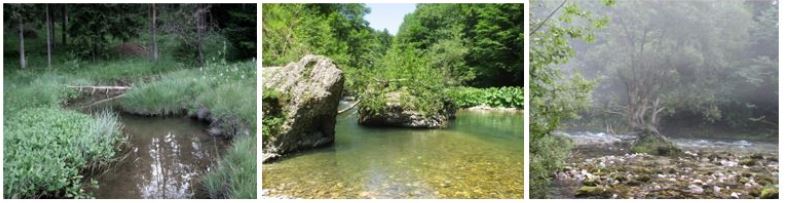
Hydromorphological characteristics of watercourses in Slovenia (Bloščica, Kokra, Radovna)
In recent decades, greater attention has been paid to changes in hydromorphological characteristics in the management of running water ecosystems. To establish sustainable management of running water ecosystems, it is important to have a good understanding of the links between natural and altered river habitats and river organism communities.
In this study, we investigated the impact of hydromorphological variables at various scales on benthic invertebrate (BI) communities in Slovenian watercourses across three ecoregions: the Alps, the Dinarides and the Pannonian Plain. We used data on BN communities from more than 300 sampling sites, covering the full range of hydromorphological alteration. For each site, we also collected data on environmental variables relating to land use, regional landscape characteristics (typology), river quality characteristics (RHQ) and river habitat modification (RHM).
We investigated the relationships between BN communities and environmental variables using canonical correspondence analysis (CCA). The RHQ variables explained a significantly larger proportion of the variability in BN communities than the RHM variables. The benthic invertebrate community responds less to the change itself than to the effect of that change on the quality characteristics of river habitats. We identified differences in the importance of environmental variables depending on the ecoregion. We determined the distribution of explained variability in BN communities across groups of environmental variables using partial CCA (pCCA). We found that typological variables shape processes at lower levels to a certain extent; however, a large proportion of the structure of BN communities depends on habitat quality characteristics, regardless of regional landscape factors. Furthermore, we were able to clearly distinguish between the effects of land use and the quality and altered state of river habitats on BN communities. When formulating water management guidelines, it is therefore necessary to take into account variables from both levels under consideration, as they explain the variability of BN communities in distinctly different ways and influence the status of water bodies.
Based on ecologically significant morphological variables, we defined a reference scenario or potential natural state of river habitats for the four main European regions, identified characteristic differences between the Alpine, lowland, Mediterranean and karst regions, and provided guidelines for the management of running water ecosystems.
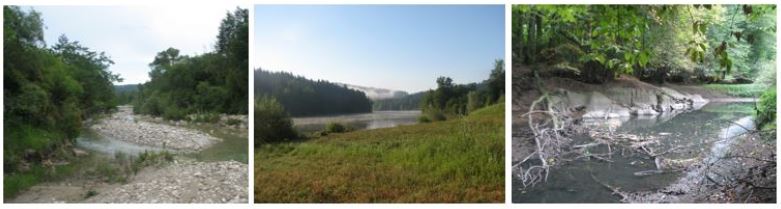
Hydromorphological characteristics of Slovenian watercourses (Dragonja, Drtiščijca, Podlomščica)
About the project
Supervisor
Assoc. Prof. Dr Gorazd Urbanič
PhD student
Dr Vesna Petkovska
Project duration
2008 – 2015
OTHER DOMESTIC REFERENCES
