.
.
22 March, World Water Day, serves as a reminder of the exceptional importance of water. It is an opportunity to raise awareness of the challenges we face in ensuring access to clean water, and of the crucial role that sustainable water management plays in achieving this goal.
As part of World Water Day, a new theme is chosen each year to highlight specific water-related challenges and solutions aimed at improving the lives of people around the world. This year’s theme, “Accelerate Change”, aims to encourage us to adopt new lifestyle habits that will include the sensible use of drinking water, water and water-related spaces in general, and their protection from pollution. In addition to the well-known chemical and biological pollutants of drinking water, in recent years experts have discovered the presence of yet another modern pollutant: microplastics. Plastic began to appear in the environment as waste almost as soon as its production began, whilst the first reports of its presence in the oceans date back to the 1980s. As plastic production increases – with global annual production approaching 400 million tonnes – the quantities of plastic waste in the environment are also rising.
In the environment, plastic waste breaks down over time into ever smaller particles, known as microplastics (particles smaller than 5 mm) and nanoplastics (particles smaller than 1 µm). Although such tiny plastic particles have been passing through various parts of the water cycle for more than half a century, their impact on the environment is only now becoming the subject of research. Microplastic and nanoplastic particles have been found in the air, soil, inland waters and the sea. Due to their size, microplastic particles can also migrate, along with surface water, into groundwater, which is the main source of drinking water in Slovenia. Their distribution across different parts of the environment depends on many highly varied factors, ranging from the properties of the particles to meteorological and hydrological conditions, which presents a challenge for research into microplastics. Although the negative impacts of microplastics on the environment are not yet fully understood, we can state with certainty that plastic does not belong in the environment. The potential interactions of microplastics with many organisms may contribute to changes in the environment from both a biological and a chemical perspective.
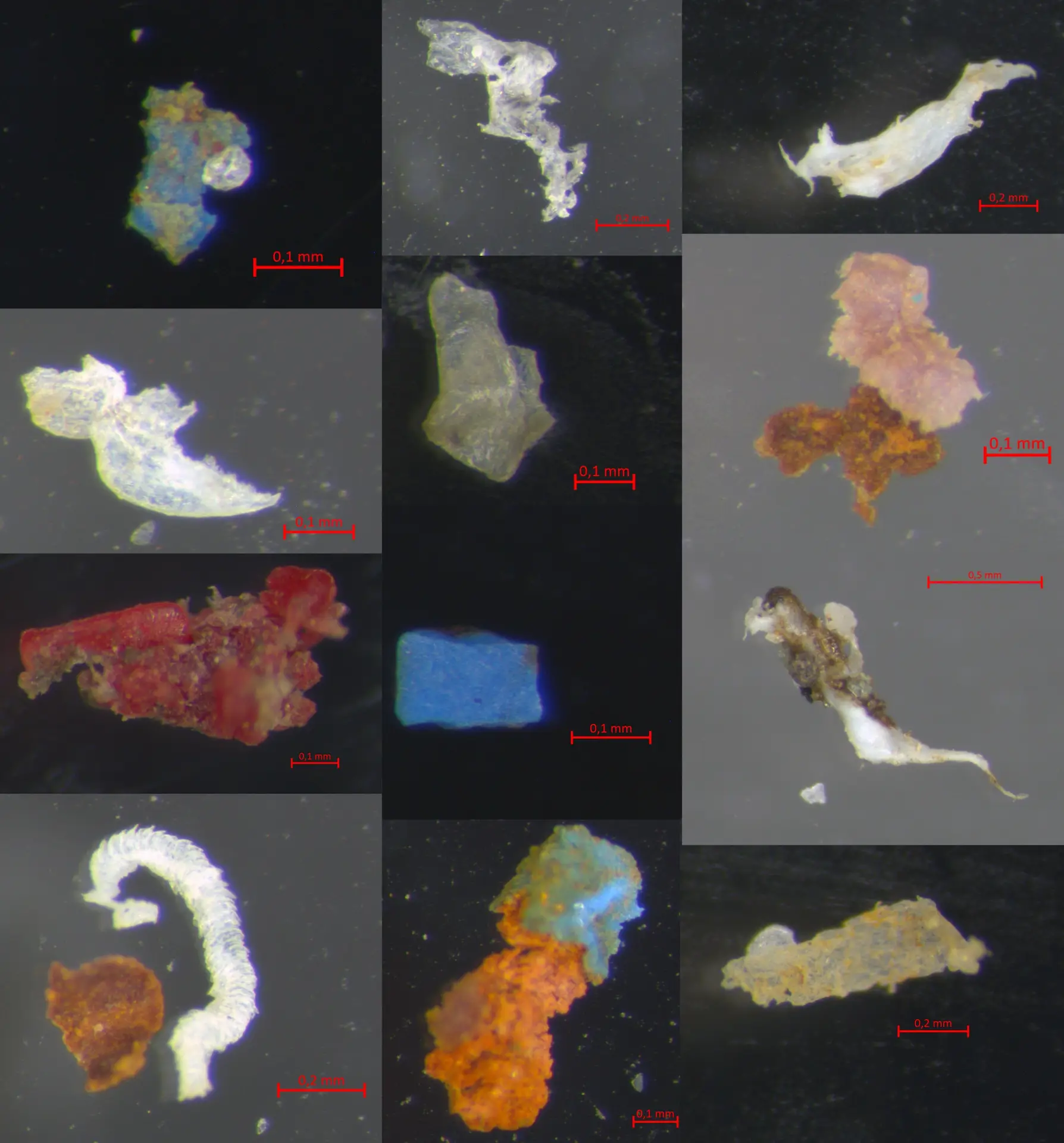
Image of microplastic particles in groundwater (Photo: Tine Bizjak, IzVRS, 2023).
This year’s World Water Day calls on us to take swifter action for the benefit of humans and other living beings, whose fate all too often depends on human activities. In addition to existing protective measures, we would like to see society take swifter action in the areas of the production, use and management of plastic products at the end of their useful life. As the recycling of plastic waste is still very limited and accounts for only a small proportion of all plastic waste, it is crucial that, as a society, we change our habits as soon as possible, step up separate waste collection and, at the same time, reduce our use of plastic products.
.
.