
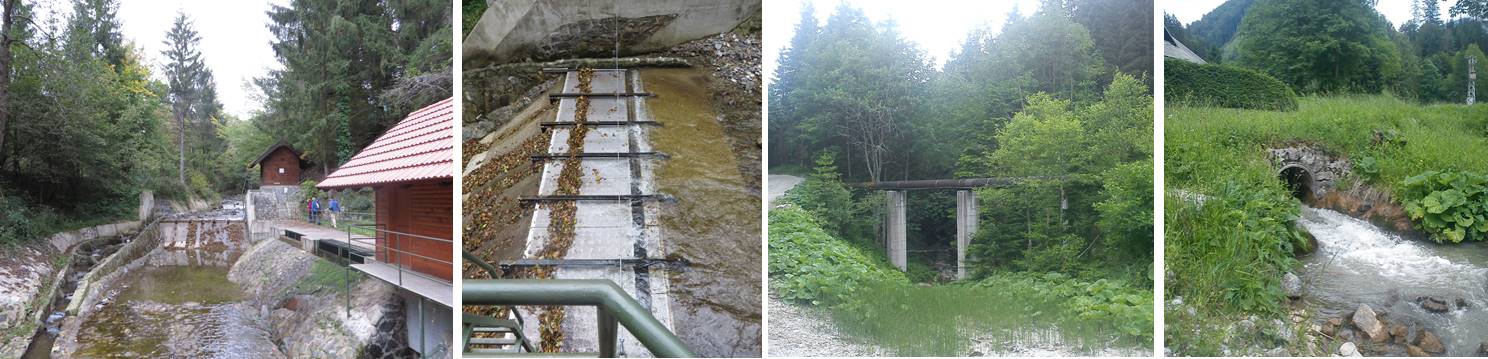
Example of a catchment, pipes and discharge resulting from the operation of a small hydropower plant
Achieving good ecological status and water abstraction are often seen as activities with conflicting objectives. The aim of the study was to determine whether, despite water abstraction from Alpine watercourses, we can achieve good ecological status and which pressure factors need to be taken into account. In Slovenia, there are a large number of small hydropower plants, the majority of which are located on Alpine watercourses, and a significant proportion of these operate by abstracting water from the watercourses. The primary aim of our research was to gain insights that would enable the existing approach set out in the Regulation on the criteria for determining, and the methods for monitoring and reporting, ecologically acceptable flow (the Qes Regulation), taking into account elements of water status and the objectives of the Water Framework Directive.
We carried out the research on small watercourses in the Alpine hydro-ecoregion. We used data on fish communities, benthic invertebrates and phytobenthos, as well as ecological status indices for all samples. As pressure data, we used hydrological parameters, hydromorphological pressure indices (indices from the Slovenian Hydromorphological Method – SIHM), land cover parameters and distance from the downstream dam. Where water abstractions were recorded, we calculated the average instantaneous abstraction, the maximum instantaneous abstraction and the ‘f’ factor from the Qes Regulation. In the study, we tested the hypothesis that Qes is a function of water abstraction, the hydromorphological characteristics of the sampling site, pollution and downstream connectivity.
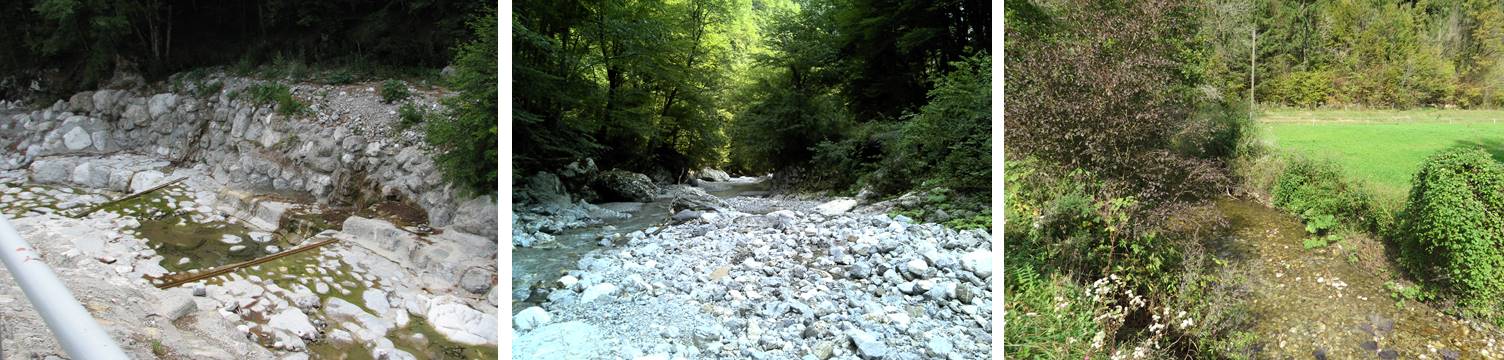
Sections affected by mHE abstractions (Kneža and Suhodolnica)
We found that benthic invertebrates and fish respond most strongly to water abstraction. As relative water abstraction increases, the ecological status of the watercourse deteriorates; however, the ecological status does not depend solely on relative water abstraction but also on other environmental factors. Based on the project’s findings, we have developed a tool for calculating water abstraction from watercourses whilst taking the ecological status into account; in other words, a calculation that will comply with the principles of current European water policy. The results of the project, together with the tool developed, can assist fishing associations, nature conservation agencies, the Ministry of the Environment and Spatial Planning, the Ministry of Agriculture, Forestry and Food, and the Ministry of Economic Development and Technology in predicting the impacts of current and planned water abstractions on the aquatic ecosystem. The tool developed may also assist applicants in obtaining water rights. The findings and results of the project will form the basis for future amendments and upgrades to the Qes Regulation, and will most likely also be applied in subsequent water management plans in Slovenia.
At the national level, the research results provide new scientific insights not only in the field of water management, but also in the fields of limnology and general biology, as no research has yet been conducted on the links between hydrological parameters and the elements of ecological status in accordance with the Water Framework Directive. Based on the study’s findings, we now have a basis for understanding the relationship between Qes and the elements of ecological status in the Alpine ecoregion; and we are also contributing to a general understanding of the impact of changes in the hydrological regime and facilitating further research in other ecoregions.
Link to further content
SICRIS:
Partners
Keywords
About the project
Project value
140,000 EUR
Client
Public Agency for Research Activities of the Republic of Slovenia
Ministry of the Environment and Spatial Planning
Ministry of Agriculture and the Environment
Project leader
Assoc. Prof. Dr Gorazd Urbanič
Project collaborators
Aleksandra Krivograd Klemenčič
Blažo Đurović
Dušan Rebolj
Gregor Kolman
Janko Zakrajšek
Sabina Blumauer
Dr Nataša Smolar-Žvanut
Dr Maja Pavlin Urbanič
Dr Gorazd Kosi
Dr Samo Podgornik
Darko Anzeljc
Maša Čarf
Assoc. Prof. Dr Tina Eleršek
Dr Mojca Hrovat
Aljaž Jenič
Miha Knehtl
Dr Tanja Mohorko
Dr Vesna Petkovska
Dr Rebeka Šiling
Dr Igor Zelnik
Project duration
2014–2016
OTHER DOMESTIC REFERENCES
